Skip to content
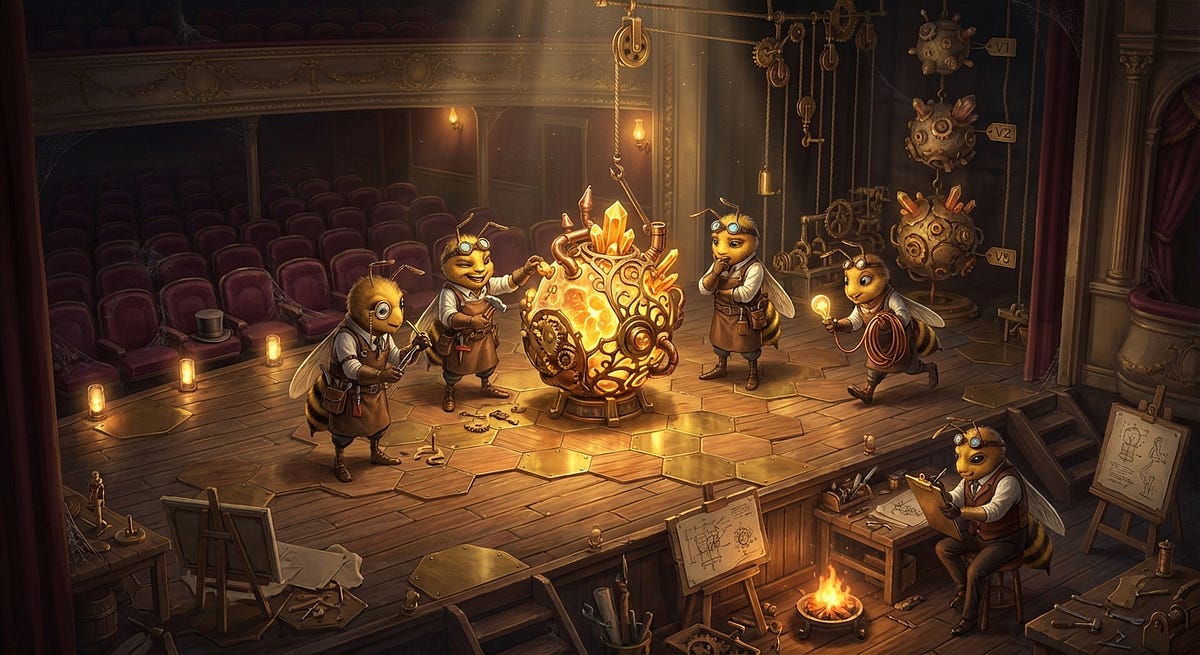
- Everyone you talk to from Anthropic will eventually mention the chaos. It is not run like any other company of this size. Every other company quickly becomes “professional” and compartmentalized and accountable and grown-up and whatnot at their size. I don’t think Anthropic has bothered with any of that crap yet.
- The employees often describe it as a hive mind run on vibes, so this isn’t me putting words in their mouths. They are observing it too. Organizations reflect their leaders, so it’s clearly being directed by leadership, and I’m sure it’s intentional. Not all the bees are the same size, and there are clearly some graph nodes spread through the hive mind that are keeping it stable.
But if you interfere with the hive mind operation, upsetting that balance, you’ll gently be pushed out to the edges, and maybe beyond. The centrifuge will spin you away to the periphery, carried by a wave of vibes.
It feels fragile, and it may have scaling ceilings we’re all unaware of. But they have kept it going so far, and I have some thoughts about how they’re managing it.
- A Golden Age is a period of intense innovation, category creation, velocity, and productivity that lasts typically several years. Golden Ages at companies have the property of attracting all the greatest talent in the industry, very quickly. That’s happening at Anthropic right now.
- Was it killing 20% work that caused the crash? Not directly. As a counterexample, Amazon never had 20% work. Their Golden Age of innovation and excitement lasted a pretty long time, much longer than after I left in 2005. So it wasn’t that. What did they have that Google didn’t?
One clue is something my colleague Jacob Gabrielson told me when he was a Principal Engineer at Amazon in maybe 2015-ish, when Google had become hardened like concrete. I told him that people often fought over projects at Google, and Jacob told me that it never happened at Amazon, because, as he put it, “Everyone here is always slightly oversubscribed.”
So now you see how the magic starts and ends. During Golden Ages, there is more work than people. And when they crash, it is because there are more people than work.
- That was the beginning of the end. As soon as there wasn’t enough work, people began to fight over the work that was left. It kicked off a wave of empire building, territoriality, politicking, land grabs, and, as Lydia Ash taught me, Cookie Licking–a phrase folks at Microsoft had invented to accuse people of claiming work that they will never actually get around to doing.
- So despite the chaos, and the inevitable growing pains (not dissimilar to when I was at Amazon during their Get Big Fast phase just after their IPO), there is never a reason to fight over work. There is infinite work.
And so everyone gets many chances to put their ideas in the sun, and the Hive Mind judges their merit.
- My strong suspicion is that Anthropic is operating the way all successful companies will soon operate within a few short years, despite it being so very different from how most operate today.
- Anyway, seeing SageOx do this, operating a hive mind with three people, made me immediately think of Anthropic. SageOx are not focused on profits either; they’re focused on discovery. They are trying to find PMF by inventing it, since this is a new category. They are working together as a mini-hive mind, automating their own work in a tight self-reinforcing loop.
Building for yourself is the only way to give your product a nonzero chance of success in the new world. Build something just for yourself, and make sure you love it so much that you know it’s how other people should be working.
- The Settlers of Catan inventor Teuber famously built new games for his own family to playtest for years, before they finally found the formula for Catan through many iterations. I like to think of them sitting around and testing out new variations of games as being very similar to how modern AI devs are building software.